Scottish explorer and missionary
| David Livingstone |
 Livingstone in 1864 |
| Born | (1813-03-19)19 March 1813
Blantyre, South Lanarkshire, Scotland |
| Died | 1 May 1873(1873-05-01) (aged 60)[1]
Chief Chitambo's Village, Kingdom of Kazembe
(today Northern Province, Zambia) |
| Resting place | Westminster Abbey
51°29′58″N 0°07′39″W / 51.499444°N 0.1275°W / 51.499444; -0.1275 |
| Known for | Proselytizing Christianity, exploration of Africa, and meeting with Henry Stanley. |
| Spouse(s) | |
| Children | 6 |
David Livingstone (; 19 March 1813 – 1 May 1873) was a Scottish physician, Congregationalist, and pioneer Christian missionary[2] with the London Missionary Society, an explorer in Africa, and one of the most popular British heroes of the late 19th-century Victorian era. He had a mythic status that operated on a number of interconnected levels: Protestant missionary martyr, working-class "rags-to-riches" inspirational story, scientific investigator and explorer, imperial reformer, anti-slavery crusader, and advocate of British commercial and colonial expansion.
Livingstone's fame as an explorer and his obsession with learning the sources of the Nile River was founded on the belief that if he could solve that age-old mystery, his fame would give him the influence to end the East African Arab–Swahili slave trade. "The Nile sources", he told a friend, "are valuable only as a means of opening my mouth with power among men. It is this power [with] which I hope to remedy an immense evil."[3] : 289 His subsequent exploration of the central African watershed was the culmination of the classic period of European geographical discovery and colonial penetration of Africa. At the same time, his missionary travels, "disappearance", and eventual death in Africa—and subsequent glorification as a posthumous national hero in 1874—led to the founding of several major central African Christian missionary initiatives carried forward in the era of the European "Scramble for Africa".[4]
Early life [edit]

Livingstone's birthplace in Blantyre

David Livingstone's birthplace, with period furnishings
Livingstone was born on 19 March 1813 in the mill town of Blantyre, Scotland, in a tenement building for the workers of a cotton factory on the banks of the River Clyde under the bridge crossing into Bothwell.[5] He was the second of seven children born to Neil Livingstone (1788–1856) and his wife Agnes (née Hunter; 1782–1865).
According to Scottish literary scholar Ronald Black, the poet Duncan Livingstone, an anti-racist and anti-colonialist poet and major figure in 20th-century Scottish Gaelic literature, grew up being told that his grandfather, Alexander Livingstone, was David Livingstone's uncle.[6]
David was employed at the age of ten in the cotton mill of Henry Monteith & Co. in Blantyre Works. He and his brother John worked twelve-hour days as piecers, tying broken cotton threads on the spinning machines.
Neil Livingstone was a Sunday school teacher and teetotaller who handed out Christian tracts on his travels as a door-to-door tea salesman. He read books on theology, travel, and missionary enterprises extensively. This rubbed off on the young David, who became an avid reader, but he also loved scouring the countryside for animal, plant, and geological specimens in local limestone quarries. Neil feared that science books were undermining Christianity and attempted to force his son to read nothing but theology, but David's deep interest in nature and science led him to investigate the relationship between religion and science. In 1832, he read Philosophy of a Future State, written by Thomas Dick, and he found the rationale that he needed to reconcile faith and science and, apart from the Bible, this book was perhaps his greatest philosophical influence.[8]
Other significant influences in his early life was Thomas Burke, a Blantyre evangelist, and David Hogg, his Sunday school teacher.[8] At age fifteen, David left the Church of Scotland for a local Congregational church, influenced by preachers like Ralph Wardlaw, who denied predestinarian limitations on salvation. Influenced by revivalistic teachings in the United States, Livingstone entirely accepted the proposition put by Charles Finney, Professor of Theology at Oberlin College, Ohio, that "the Holy Spirit is open to all who ask it". For Livingstone, this meant a release from the fear of eternal damnation.[3] : 13 Livingstone's reading of missionary Karl Gützlaff's Appeal to the Churches of Britain and America on behalf of China enabled him to persuade his father that medical study could advance religious ends.[9]
Livingstone's experiences in H. Monteith's Blantyre cotton mill were also important from ages 10 to 26, first as a piecer and later as a spinner. This monotonous work was necessary to support his impoverished family, but it taught him persistence, endurance, and a natural empathy with all who labour, as expressed by lines that he used to hum from the egalitarian Rabbie Burns song: "When man to man, the world o'er/Shall brothers be for a' that".[a]
Education [edit]
Livingstone attended Blantyre village school, along with the few other mill children with the endurance to do so despite their 14-hour workday (6 am–8 pm). Having a family with a strong, ongoing commitment to study reinforced his education. After reading the appeal by Gutzlaff for medical missionaries for China in 1834, he began saving money to enter Anderson's University, Glasgow in 1836, where he made lifelong friends including James Young, as well as attending Greek and theology lectures at the University of Glasgow.[10]
To enter medical school, he required some knowledge of Latin. He was tutored by a local Roman Catholic man, Daniel Gallagher. Later in life, Gallagher became a priest and founded the third oldest Catholic Church in Glasgow: St Simon's, Partick.[11] In addition to his other studies, he attended divinity lectures by Wardlaw, a leader at this time of vigorous anti-slavery campaigning in the city.
Shortly after, he applied to join the London Missionary Society (LMS) and was accepted subject to missionary training. He was a student at the Charing Cross Hospital Medical School in 1838–40, with his courses covering medical practice, midwifery, and botany. During this period he also spent time on missionary training in London and in Ongar, Essex, to become a minister within the Congregational Union serving under the LMS. While training under the LMS, he and other students were taught Greek, Latin, Hebrew and theology by the Reverend Richard Cecil.[3] Despite his impressive personality, he was a plain preacher, described by Cecil as "worthy but remote from brilliant"[3] and would have been rejected by the LMS had the director not given him a second chance to pass the course.[8] He qualified as a Licentiate of the Faculty (now Royal College) of Physicians and Surgeons of Glasgow on 16 November 1840, and was later made an Honorary Fellow of the Faculty, on 5 January 1857.[12]
Vision for Africa [edit]
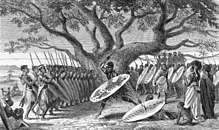
Zulu dance, from Livingstone's Narrative of an Expedition to the Zambesi and its Tributaries
Livingstone hoped to go to China as a missionary, but the First Opium War broke out in September 1839 and the LMS suggested the West Indies instead. In 1840, while continuing his medical studies in London, Livingstone met LMS missionary Robert Moffat, on leave from Kuruman, a missionary outpost in South Africa, north of the Orange River. He was excited by Moffat's vision of expanding missionary work northwards, and by abolitionist T.F. Buxton's arguments that the African slave trade could be destroyed by substituting "legitimate trade" and spreading Christianity.[9] When he questioned if he would do for Africa, Livingstone was deeply influenced by Moffat's affirmation that, instead of going to an old mission, he should go to the vast plains to the north of Bechuanaland, where Moffat had glimpsed "the smoke of a thousand villages, where no missionary had ever been."[8] Livingstone set off on 8 December 1840, passenger on a sailing brig. During the long voyage he studied Dutch and Tswana language, and the captain gave him extensive tuition in navigation.
On 15 March 1841 the ship arrived at Cape Town, where he stayed with Dr. Philip who defended Xhosa people, and learnt of colonist and missionary factions opposed to native rights. The ship took Livingstone on to Algoa Bay, from 19 May to 31 July he was on the long trek to the Kuruman Mission. The Moffats had not yet returned from Britain, he immersed himself in Tswana life and from September to late December went a long trek with the missionary Roger Edwards who had been at Kuruman since 1830. In 1842 Lingstone went on two trecks with African companians, the principals were mission members Paul and Mebalwe, a deacon. In June 1843, Edwards got LMS approval to set up a mission station with his wife at Mabotsa, Botswana (near Zeerust, North West Province, South Africa.[15]). Livingstone moved there with them and helped to build the mission station. He wrote to tell LMS secretary Arthur Tidman, saying he would be delighted to call Mabotsa "the centre of the sphere of my labours", but would try to hold himself "in readiness to go anywhere, provided it be forward".[17]
The Moffats reached the Vaal River in January 1844, Livingstone rode out to meet them there, then sat in the ox-cart talking with Robert for hours during the seventeen or eighteen days it took to get home to Kuruman. For the first time, he met their daughter Mary, who had been born and brought up in Africa.
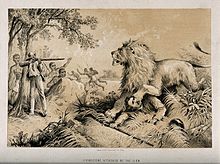
Deacon Mebalwe shooting, distracting the lion which had overpowered Livingstone.
Lions often attacked herds of the Mabotsa villagers, on 16 February Mebalwe and Livingstone joined them defending sheep.[19] Livingstone got a clear shot at a large lion, but while he was re-loading it attacked, crushing his left arm, and forced him to the ground. His life was saved by Mebalwe diverting its attention by trying to shoot the lion. He too got bitten, a man who tried spearing it was attacked just before it dropped dead. [21]
Livingstone's broken bone, even though inexpertly set by himself and Edwards, bonded strongly. He went for recuperation to Kuruman, where he was tended by Moffat's daughter Mary, and they became engaged. His arm healed, enabling him to shoot and lift heavy weights, though it remained a source of much suffering for the rest of his life, and he was not able to lift the arm higher than his shoulder.[8]
Livingstone and Mary were married on 9 January 1845.[22]
Exploration of southern and central Africa [edit]

The journeys of Livingstone in Africa between 1851 and 1873
Livingstone was obliged to leave his first mission at Mabotsa in Botswana in 1845 after irreconcilable differences emerged between him and his fellow missionary, Rogers Edwards, and because the Bakgatla were proving indifferent to the Gospel. He abandoned Chonuane, his next mission, in 1847 because of drought and the proximity of the Boers and his desire "to move on to the regions beyond".[3] : 65, 73–4 At Kolobeng Mission Livingstone converted Chief Sechele in 1849 after two years of patient persuasion, but only a few months later Sechele lapsed.[23]
In 1851, when Livingstone finally left Kolobeng, he did not use this failure to explain his departure, although it played an important part in his decision. Just as important had been the three journeys far to the north of Kolobeng which he had undertaken between 1849 and 1851 and which had left him convinced that the best long-term chance for successful evangelising was to explore Africa in advance of European commercial interest and other missionaries by mapping and navigating its rivers which might then become "Highways" into the interior.[3] : 82, 93, 103–105, 108
Livingstone departed from the village of Linyanti, located roughly in the center of the continent on the Zambezi river. Livingstone had reached this point coming from the south, in Cape Town, it was the northern frontier missionary post. Livingstone set out from Linyanti to the north-west, up the Zambezi, believing this would map the best "highway" into Africa. He had the help of 27 African guides and warriors loaned by Sekeletu, chief of the Kololo in Linyanti. They reached the Portuguese city of Luanda on the Atlantic after profound difficulties and the near-death of Livingstone from fever. Livingstone realized the route would be too difficult for future traders, so he retraced the journey back to Linyanti. Then with 114 men, loaned by the same chief, he set off east down the Zambezi. On this leg he became the first European to see the Mosi-oa-Tunya ("the smoke that thunders") waterfall, which he named Victoria Falls after Queen Victoria. Eventually he successfully reached Quelimane on the Indian Ocean, having mapped most of the course of the Zambezi river.[3] : 126, 147–8
In this way Livingstone became the first European to cross south-central Africa which had never been crossed by Europeans at that latitude before. Livingstone's accomplishment made him famous.[3] : 126, 147–8 But it was not wholly without precedent; a few years earlier, in 1853–1854, two Arab traders crossed the continent from Zanzibar to Benguela; and in the first decade of the 1800s, two native traders crossed from Angola to Mozambique; and Portuguese traders had already penetrated to the middle of the continent from both sides. Nonetheless, the Portuguese had not made the full crossing and the non-European accomplishments were little known or cared about in Europe. Therefore, Livingstone was hailed the explorer who "opened up" Africa.

Livingstone preaching the gospel to unconverted Africans. Like other missionaries of the era he had a low success rate and is credited with a single conversion.
Livingstone advocated the establishment of trade and religious missions in central Africa, but abolition of the African slave trade, as carried out by the Portuguese of Tete and the Arab Swahili of Kilwa, became his primary goal. His motto—now inscribed on his statue at Victoria Falls—was " Christianity, Commerce and Civilization ", a combination that he hoped would form an alternative to the slave trade, and impart dignity to the Africans in the eyes of Europeans.[26] He believed that the key to achieving these goals was the navigation of the Zambezi River as a Christian commercial highway into the interior.[27]
[edit]
He returned to Britain in December 1856, his work as a geographer was recognised by the Royal Geographical Society which presented him with their gold medal. Encouraged by the London Missionary Society, he wrote up his journal, but unconventionally had his Missionary Travels published in 1857 by John Murray, making it a bestselling travelogue. The book included his field science, and exceptionally sympathetic descriptions of African people. He proposed that missions and "legitimate commerce" by river into central Africa would end slave trading.[28]

Slave traders and their captives bound in chains and collared with 'taming sticks'. From Livingstone's Narrative
Livingstone was encouraged by the response in Britain to his discoveries and support for future expeditions. He proposed to do more exploration, primarily to find routes for commercial trade which he believed would displace slave trade routes, more so than for solely missionary work. The London Missionary Society (LMS) on learning of his plans sent a letter which Livingstone received at Quelimane, congratulating him on his journey but said that the directors were "restricted in their power of aiding plans connected only remotely with the spread of the Gospel".[3] : 156 This brusque rejection for new mission stations north of the Zambesi and his wider object of opening the interior for trade via the Zambezi, was not enough to make him resign from the LMS at once. When Roderick Murchison, president of the Royal Geographical Society, put him in touch with the Foreign Secretary, Livingstone said nothing to the LMS directors, even when his leadership of a government expedition to the Zambezi seemed increasingly likely to be funded by the Exchequer. "I am not yet fairly on with the Government," he told a friend, "but am nearly quite off with the Society (LMS)." Livingstone resigned from the London Missionary Society in 1857, and in May of that year he was appointed as Her Majesty's Consul with a roving commission, extending through Mozambique to the areas west of it.[30] In February 1858 his area of jurisdiction was stipulated to be "the Eastern Coast of Africa and the independent districts in the interior".[31]
While he negotiated with the government for his new position as Consul, the LMS thought that he would return to Africa with their mission to the Kololo in Barotseland, which Livingstone had promoted.[3] : 169–171, 189 That mission eventually suffered deaths from malaria of a missionary, his wife, a second missionary's wife and three children. Livingstone had suffered over thirty attacks during his previous journey but had understated his suffering and overstated the quality of the land they would find, and the missionaries set out for the marshy region with wholly inadequate supplies of quinine. Biographer Tim Jeal considered this episode a major failing for Livingstone, and indicative of a pattern of putting his goals and career above the lives of those around him.[3] : 159, 176–185
Livingstone was now a celebrity, in great demand as a public speaker, and was elected to the Royal Society. He gained public backing for his plans, and raised finances for his next expedition by public subscription, as well as £5,000 from the government to investigate the potential for British trade via the Zambezi.[28]
Zambezi expedition [edit]
In December 1857 the Foreign Office proposed a huge expedition. Livingstone had envisaged another solo journey with African helpers, in January 1858 he agreed to lead a second Zambesi expedition with six specialist officers, hurriedly recruited in the UK.[28]
The prefabricated iron river steamer Ma Robert was quickly built in portable sections, and loaded onto the Colonial Office steamer Pearl, which took them out on its way to Ceylon. They left on 10 March, at Freetown collected twelve Kru seafarers to man the river steamer, and reached the Zambezi on 14 May. The plan was for both ships to take them up the river to establish bases, but it turned out to be completely impassable to boats past the Cahora Bassa rapids, a series of cataracts and rapids that Livingstone had failed to explore on his earlier travels. Pearl offloaded their supplies on an island about 40 miles (64 km) upstream. From there, Ma Robert had to make repeated slow journeys, getting hauled across shoals. The riverbanks were a war zone, with Portuguese soldiers and their slaves fighting the Chikunda slave-hunters of Matakenya (Mariano), but both sides accepted the expedition as friends. [34]

Burial site of Mary Moffat Livingstone in Chupanga, Mozambique
The experts, stuck at Shupanga, could not make the intended progress, and there were disagreements. Artist Thomas Baines was dismissed from the expedition. Others on the expedition became the first to reach Lake Nyasa and they explored it in a four-oared gig. In 1861 the Colonial Office provided a new wooden paddle survey vessel, Pioneer, which took the Universities' Mission to Central Africa (UMCA) led by Bishop Charles MacKenzie up the Shire river to found a new mission.
Livingstone raised funds for a replacement river steamer, Lady Nyasa, specially designed to sail on Lake Nyasa. It was shipped out in sections, contary to his request, with a mission party including Mary Livingstone, and arrived in 1862. The Pioneer was delayed getting down to the coast to meet them, and there were further delays after it was found that the Bishop had died. Mary Livingstone died on 27 April 1862 from malaria.
Livingstone took Pioneer up the coast and investigated the Ruvuma River, the physician John Kirk wrote "I can come to no other conclusion than that Dr Livingstone is out of his mind and a most unsafe leader".
When Pioneer returned to Shupanga in December 1862, they paid (in cloth) their "Mazaro men" who left and engaged replacements. On 10 January 1863 they set off, towing Lady Nyasa, and went up the Shire river past scenes of devastation as Mariano's Chikunda slave-hunts caused famine, and they frequently had to clear the paddle wheels of corpses left floating downstream. They reached Chibisa's and the Murchison Cataracts in April, then began dismantling Lady Nyasa and building a road to take its sections past the cataracts, while explorations continued.
He brought the ships downriver in 1864 after the government ordered the recall of the expedition. The Zambezi Expedition was castigated as a failure in many newspapers of the time, and Livingstone experienced great difficulty in raising funds to further explore Africa. John Kirk, Charles Meller, and Richard Thornton, scientists appointed to work under Livingstone, contributed large collections of botanical, ecological, geological, and ethnographic material to scientific Institutions in the United Kingdom.
Nile River [edit]
In January 1866, Livingstone returned to Africa, this time to Zanzibar, and from there he set out to seek the source of the Nile. Richard Francis Burton, John Hanning Speke, and Samuel Baker had identified either Lake Albert or Lake Victoria as the source (which was partially correct, as the Nile "bubbles from the ground high in the mountains of Burundi halfway between Lake Tanganyika and Lake Victoria"), but there was still serious debate on the matter. Livingstone believed that the source was farther south and assembled a team to find it consisting of freed slaves, Comoros Islanders, twelve Sepoys, and two servants from his previous expedition, Chuma and Susi.[ citation needed ]

This house in Mikindani in southern Tanzania was the starting point for Livingstone's last expedition. He stayed here from 24 March to 7 April 1866.
Livingstone set out from the mouth of the Ruvuma river, but his assistants gradually began deserting him. The Comoros Islanders had returned to Zanzibar and (falsely) informed authorities that Livingstone had died. He reached Lake Malawi on 6 August, by which time most of his supplies had been stolen, including all his medicines. Livingstone then travelled through swamps in the direction of Lake Tanganyika, with his health declining. He sent a message to Zanzibar requesting that supplies be sent to Ujiji and he then headed west, forced by ill health to travel with slave traders. He arrived at Lake Mweru on 8 November 1867 and continued on, travelling south to become the first European to see Lake Bangweulu. Upon finding the Lualaba River, Livingstone theorised that it could have been the high part of the Nile River; but realised that it in fact flowed into the River Congo at Upper Congo Lake.[38]
The year 1869 began with Livingstone finding himself extremely ill while in the jungle. He was saved by Arab traders who gave him medicines and carried him to an Arab outpost. In March 1869, Livingstone suffered from pneumonia and arrived in Ujiji to find his supplies stolen. He was coming down with cholera and had tropical ulcers on his feet, so he was again forced to rely on slave traders to get him as far as Bambara—where he was caught by the wet season. With no supplies, Livingstone had to eat his meals in a roped-off enclosure for the entertainment of the locals in return for food.[ citation needed ]
On 15 July 1871,[40] Livingstone recorded in his field diary his immediate impressions as he witnessed around 400 Africans being massacred by Arab slavers at the Nyangwe market on the banks of the Lualaba River, while he was watching next the leading Arab trader Dugumbe who had given him assistance. [42]
The cause behind this attack is stated to be retaliation for actions of Manilla, the head slave who had sacked villages of Mohombo people at the instigation of the Wagenya chieftain Kimburu. The Arabs attacked the shoppers and Kimburu's people. [42]
Researchers from the Indiana University of Pennsylvania who scanned Livingstone's diary suggest that in putting his fragmentary notes about the massacre into the narrative of his journal, he left out his concerns about some of his followers, slaves owned by Banyan merchants who had been hired by John Kirk, acting Consul at Zanzibar, and sent to get Livingstone to safety. These slave had been liberated and added to his party, but had shown violent conduct against local people contrary to his instructions, and he feared they might have been involved in starting the massacre. His diary noted "Dugumbe's men murdering Kimburu and another for slaves" and implied that the slave Manilla played a leading part, but looking back at the events, he says Dugumbé's people bore responsibility, and started it to make an example of Manilla. In the diary he described his sending his men with protection of a flag to assist Manilla's brother, in his journal version it was to assist villagers. The version edited by Waller in the "Last Journals", published in 1874, left out the context of Livingstone's earlier comments about Kirk and bad behaviour of the hired Banyan men, and omitted the villagers' earlier violent resistance to Arab slavers, so it portrayed the villagers as passive victims. The section on the massacre itself had only minor grammatical corrections. Further research into diary notes continues.[43] [42]
The massacre horrified Livingstone, leaving him too shattered to continue his mission to find the source of the Nile. Following the end of the wet season, he travelled 240 miles (390 km) from Nyangwe back to Ujiji, an Arab settlement on the eastern shore of Lake Tanganyika – violently ill most of the way – arriving on 23 October 1871.[ citation needed ]
Geographical discoveries [edit]
Livingstone was wrong about the Nile, but he identified numerous geographical features for Western science, such as Lake Ngami, Lake Malawi, and Lake Bangweulu, in addition to Victoria Falls mentioned above.[ citation needed ] He filled in details of Lake Tanganyika, Lake Mweru, and the course of many rivers, especially the upper Zambezi, and his observations enabled large regions to be mapped which previously had been blank. Even so, the farthest north he reached was the north end of Lake Tanganyika – still south of the Equator – and he did not penetrate the rainforest of the River Congo any farther downstream than Ntangwe near Misisi.[44]
Livingstone was awarded the gold medal of the Royal Geographical Society of London and was made a Fellow of the society, with which he had a strong association for the rest of his life.[8]
Stanley meeting [edit]

Livingstone Memorial Sculpture in Blantyre

Henry Morton Stanley meets David Livingstone

Livingstone Memorial in Ujiji, Tanzania
Livingstone completely lost contact with the outside world for six years and was ill for most of the last four years of his life. Only one of his 44 letter dispatches made it to Zanzibar. One surviving letter to Horace Waller was made available to the public in 2010 by its owner Peter Beard. It reads: "I am terribly knocked up but this is for your own eye only... Doubtful if I live to see you again..."[45] [46]
Henry Morton Stanley had been sent to find him by the New York Herald newspaper in 1869. He found Livingstone in the town of Ujiji on the shores of Lake Tanganyika on 10 November 1871,[47] apparently greeting him with the now famous words "Dr Livingstone, I presume?" Livingstone responded, "Yes", and then, "I feel thankful that I am here to welcome you." These famous words may have been a fabrication, as Stanley later tore out the pages of this encounter in his diary.[48] Even Livingstone's account of this encounter does not mention these words. However, the phrase appears in a New York Herald editorial dated 10 August 1872, and the Encyclopædia Britannica and the Oxford Dictionary of National Biography both quote it without questioning its veracity. The words are famous because of their perceived humour, Livingstone being the only other white person for hundreds of miles, along with Stanley's clumsy attempt at appearing dignified in the bush of Africa by making a formal greeting one might expect to hear in the confines of an upper-class London club. However, readers of the Herald immediately saw through Stanley's pretensions.[48] As noted by his biographer Tim Jeal, Stanley struggled his whole life with a self-perceived weakness of being from a humble background, and manufactured events to make up for this supposed deficiency.[48] Stanley's book suggests that this greeting was truly motivated by embarrassment, because he did not dare to embrace Livingstone.[ citation needed ]
Despite Stanley's urgings, Livingstone was determined not to leave Africa until his mission was complete. His illness made him confused and he had judgment difficulties at the end of his life. He explored the Lualaba and, failing to find connections to the Nile, returned to Lake Bangweulu and its swamps to explore possible rivers flowing out northwards.
Christianity and Sechele [edit]
Livingstone is known as "Africa's greatest missionary," yet he is recorded as having converted only one African: Sechele, who was the chief of the Kwena people of Botswana (Kwena are one of the main Sotho-Tswana clans, found in South Africa, Lesotho, and Botswana[49] in all three Sotho-Tswana language groupings). Sechele was born in 1812. His father died when Sechele was 10, and two of his uncles divided the tribe, which forced Sechele to leave his home for nine years. When Sechele returned, he took over one of his uncle's tribes; at that point, he met Livingstone. [ pages needed ] Livingstone immediately became interested in Sechele, and especially his ability to read. Being a quick learner, Sechele learned the alphabet in two days and soon called English a second language. After teaching his wives the skill, he wrote the Bible in his native tongue.
Livingstone was known through a large part of Africa for treating the natives with respect, and the tribes that he visited returned his respect with faith and loyalty. He could never permanently convert the tribesmen to Christianity, however. Among other reasons, Sechele, by then the leader of the African tribe, did not like the way that Livingstone could not demand rain of his God like his rainmakers, who said that they could. After long hesitation from Livingstone, he baptised Sechele and had the church completely embrace him. Sechele was now a part of the church, but he continued to act according to his African culture, which went against Livingstone's teachings.[52] : 20
Sechele was no different from any other man of his tribe in believing in polygamy. He had five wives, and when Livingstone told him to get rid of four of them, it shook the foundations of the Kwena tribe. After he finally divorced the women, Livingstone baptised them all and everything went well. However, one year later one of his ex-wives became pregnant and Sechele was the father. Sechele begged Livingstone not to give up on him because his faith was still strong, but Livingstone left the country and went north to continue his Christianizing attempts.[26] [ pages needed ]
After Livingstone left the Kwena tribe, Sechele remained faithful to Christianity and led missionaries to surrounding tribes as well as converting nearly his entire Kwena people. In the estimation of Neil Parsons of the University of Botswana, Sechele "did more to propagate Christianity in 19th-century southern Africa than virtually any single European missionary". Although Sechele was a self-proclaimed Christian, many European missionaries disagreed. The Kwena tribe leader kept rainmaking a part of his life as well as polygamy.[49]
Death [edit]

David Livingstone Medal[53]
Livingstone died on 1 May 1873 at the age of 60 in Chief Chitambo's village at Chipundu, southeast of Lake Bangweulu, in present-day Zambia, from malaria and internal bleeding due to dysentery. Led by his loyal attendants Chuma and Susi, his expedition arranged funeral ceremonies. They removed his heart and buried it under a tree near the spot where he died, which has been identified variously as a mvula tree or a baobab tree but is more likely to be a mpundu tree, baobabs are found at lower altitudes and in more arid regions.[54] That site, now known as the Livingstone Memorial,[56] lists his date of death as 4 May, the date reported (and carved into the tree's trunk) by Chuma and Susi; but most sources consider 1 May—the date of Livingstone's final journal entry—as the correct one.
The expedition led by Chuma and Susi then carried the rest of his remains, together with his last journal and belongings, on a journey that took 63 days to the coastal town of Bagamoyo, a distance exceeding 1,000 miles (1,600 km). Seventy-nine followers completed the journey, the men were paid their due wages, and Livingstone's remains were returned by ship to Britain for burial. In London, his body lay in repose at No.1 Savile Row, then the headquarters of the Royal Geographical Society, prior to interment at Westminster Abbey.[8] [58] [59]
Livingstone and slavery [edit]

Arab slave traders and their captives
And if my disclosures regarding the terrible Ujijian slavery should lead to the suppression of the East Coast slave trade, I shall regard that as a greater matter by far than the discovery of all the Nile sources together.
—Livingstone in a letter to the editor of the New York Herald [47]
While talking about the slave trade in East Africa in his journals:
To overdraw its evil is a simple impossibility.
Livingstone wrote about a group of slaves forced to march by Arab slave traders in the African Great Lakes region when he was travelling there in 1866:
We passed a slave woman shot or stabbed through the body and lying on the path: a group of men stood about a hundred yards off on one side, and another of the women on the other side, looking on; they said an Arab who passed early that morning had done it in anger at losing the price he had given for her, because she was unable to walk any longer. 27th June 1866 - To-day we came upon a man dead from starvation, as he was very thin. One of our men wandered and found many slaves with slave-sticks on, abandoned by their masters from want of food; they were too weak to be able to speak or say where they had come from; some were quite young.
—Livingstone 1874, p. 62
He also described:
The strangest disease I have seen in this country seems really to be broken-heartedness, and it attacks free men who have been captured and made slaves... Twenty one were unchained, as now safe; however all ran away at once; but eight with many others still in chains, died in three days after the crossing. They described their only pain in the heart, and placed the hand correctly on the spot, though many think the organ stands high up in the breast-bone.
—Livingstone 1874, p. 352
Livingstone's letters, books, and journals did stir up public support for the abolition of slavery;[1] however, he became dependent for assistance on the very slave-traders whom he wished to put out of business. He was a poor leader of his peers, and he ended up on his last expedition as an individualist explorer with servants and porters but no expert support around him. At the same time, he did not use the brutal methods of maverick explorers such as Stanley to keep his retinue of porters in line and his supplies secure. For these reasons, he accepted help and hospitality from 1867 onwards from Mohamad Bogharib and Mohamad bin Saleh (also known as "Mpamari"), traders who kept and traded in slaves, as he recounts in his journals. They, in turn, benefited from Livingstone's influence with local people, which facilitated Mpamari's release from bondage to Mwata Kazembe. Livingstone was furious to discover that some of the replacement porters sent at his request from Ujiji were slaves.
Livingstone's figures on slaves have however been criticised as highly exaggerated.[61] [62]
Legacy [edit]

A new statue of David Livingstone on the Zambian side of Victoria Falls
By the late 1860s Livingstone's reputation in Europe had suffered owing to the failure of the missions he set up, and of the Zambezi Expedition; and his ideas about the source of the Nile were not supported. His expeditions were hardly models of order and organisation. His reputation was rehabilitated by Stanley and his newspaper,[27] and by the loyalty of Livingstone's servants whose long journey with his body inspired wonder. The publication of his last journal revealed stubborn determination in the face of suffering.[8]
In 1860, the Universities' Mission to Central Africa was founded at his request. Many important missionaries, such as Leader Stirling and Miss Annie Allen, would later work for this group. This group and the medical missionaries it sponsored came to have major, positive impact on the people of Africa.[63]
Livingstone made geographical discoveries for European knowledge. He inspired abolitionists of the slave trade, explorers, and missionaries. He opened up Central Africa to missionaries who initiated the education and healthcare for Africans, and trade by the African Lakes Company. He was held in some esteem by many African chiefs and local people and his name facilitated relations between them and the British.[8]
Partly as a result, within 50 years of his death, colonial rule was established in Africa, and white settlement was encouraged to extend further into the interior. However, what Livingstone envisaged for "colonies" was not what we now know as colonial rule, but rather settlements of dedicated Christian Europeans who would live among the people to help them work out ways of living that did not involve slavery.[26] Livingstone was part of an evangelical and nonconformist movement in Britain which during the 19th century helped change the national mindset from the notion of a divine right to rule 'lesser races', to more modernly ethical ideas in foreign policy.[64]
The David Livingstone Centre in Blantyre celebrates his life and is based in the house in which he was born, on the site of the mill in which he started his working life. His Christian faith is evident in his journal, in which one entry reads: "I place no value on anything I have or may possess, except in relation to the kingdom of Christ. If anything will advance the interests of the kingdom, it shall be given away or kept, only as by giving or keeping it I shall promote the glory of Him to whom I owe all my hopes in time and eternity."[65]
According to Alvyn Austin in 1997:[66]
During the anti-colonial 1960s, Livingstone was debunked: he made only one certified convert, who later backslid; he explored few areas not already traveled by others; he freed few slaves; he treated his colleagues horribly; he traveled with Arab slave traders; his family life was in shambles—in short, to many he embodied the "White Man's Burden" mentality. Nonetheless, at a time when countries are being renamed and statues are being toppled, Livingstone has not fallen. Despite modern Africans' animosity toward other Europeans, such as Cecil Rhodes, Livingstone endures as a heroic legend. Rhodesia has long since purged its name, but the cities of Livingstone (Zambia) and Livingstonia (Malawi) keep the explorer's appellation with pride.
In 2002, David Livingstone was named among the 100 Greatest Britons following a UK-wide vote.[67]
Family life [edit]
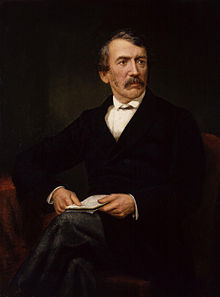
Posthumous portrait of David Livingstone by Frederick Havill
While Livingstone had a great impact on British imperialism, he did so at a tremendous cost to his family. In his absences, his children grew up missing their father, and his wife Mary (daughter of Mary and Robert Moffat), whom he married in 1845, endured very poor health, and died of malaria on 27 April 1862.[68]
He had six children:
- Robert died in the American Civil War;[69] He took the name Rupert Vincent and was the substitute for Horace Heath, and took his place in Company H of the 3rd New Hampshire Volunteers. Robert ended up being captured and he died at the Salisbury POW camp in North Carolina.[70]
- Agnes (born 1847 or 1857, died 1912; married A.L. Bruce, a wealthy Scottish brewery executive.)
- Thomas, died in Egypt in 1876 at the age of 27 from bilharzia, a disease he contracted as a child living in Africa.
- Elizabeth (who died at two months)
- William Oswell (nicknamed Zouga because of the river along which he was born, in 1851; died in 1892 in Trinidad where he practiced medicine.)
- Anna Mary (born 1858, died 1939)
Only Agnes, William Oswell and Anna Mary married and had children.[72] His one regret in later life was that he did not spend enough time with his children.[73]
Archives [edit]
The archives of David Livingstone are maintained by the Archives of the University of Glasgow (GUAS). On 11 November 2011, Livingstone's 1871 Field Diary, as well as other original works, was published online for the first time by the David Livingstone Spectral Imaging Project.[74]
Papers relating to Livingstone's time as a London Missionary Society missionary (including hand-annotated maps of South East Africa) are held by the Archives of the School of Oriental and African Studies.[75]
Digital archives unifying these and other sources are made publicly available by the Livingstone Online project at the University of Nebraska-Lincoln.[76] [77] [ citation needed ]
Place names and other memorials [edit]
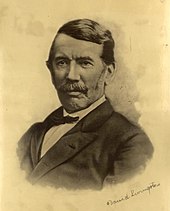
Photograph of Livingstone in later life
Africa [edit]
- The Livingstone Memorial in Ilala, Zambia marks where David Livingstone died
- The city of Livingstone, Zambia, which includes a memorial in front of the Livingstone Museum and a new statue erected in 2005.[78]
- The Rhodes–Livingstone Institute in Livingstone and Lusaka, Zambia, 1940s to 1970s, was a pioneering research institution in urban anthropology.[ citation needed ]
- David Livingstone Teachers' Training College, Livingstone, Zambia.
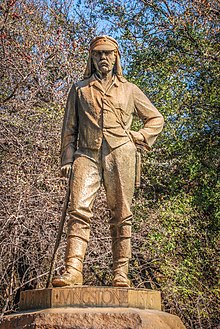
- The David Livingstone Memorial statue at Victoria Falls, Zimbabwe, erected in 1934 on the western bank of the falls.[79] Michler 2007 quoted 1954 which is wrong. The statue was unveiled on 5 August 1934[80]
- A new statue of David Livingstone was erected in November 2005 on the Zambian side of Victoria Falls.[78]
- A plaque was unveiled in November 2005 at Livingstone Island on the lip of Victoria Falls marking where Livingstone stood to get his first view of the falls.[78]
- Livingstone Hall, Men's Hall of residence at Makerere University, Kampala, Uganda.
- The town of Livingstonia, Malawi.
- The city of Blantyre, Malawi is named after Livingstone's birthplace in Scotland, and includes a memorial.
- The David Livingstone Scholarships for students at the University of Malawi, funded through Strathclyde University, Scotland.
- The David Livingstone Clinic was founded by the University of Strathclyde's Millennium Project in Lilongwe, Malawi.[81]
- The Kipengere Range in south-west Tanzania at the north-eastern end of Lake Malawi is also called the Livingstone Mountains.
- Livingstone Falls on the River Congo, named by Stanley.
- The Livingstone Inland Mission, a Baptist mission to the Congo Free State 1877–1884, located in present-day Kinshasa, Zaire.
- A memorial in Ujiji commemorates his meeting with Stanley.[82]
- The Livingstone–Stanley Monument in Mugere (present-day Burundi) marks a spot that Livingstone and Stanley visited on their exploration of Lake Tanganyika, mistaken by some as the first meeting place of the two explorers.
- Scottish Livingstone Hospital in Molepolole 50 km west of Gaborone, Botswana
- There is a memorial to Livingstone at the ruins of the Kolobeng Mission, 40 km west of Gaborone, Botswana.
- The church tower of the Holy Ghost Mission (Roman Catholic) in Bagamoyo, Tanzania, is sometimes called "Livingstone Tower" as Livingstone's body was laid down there for one night before it was shipped to London.[ citation needed ]
- Livingstone House in Stone Town, Zanzibar, provided by the Sultan for Livingstone's use, January to March 1866, to prepare his last expedition; the house was purchased by the Zanzibar government in 1947.[ citation needed ]
- Plaque commemorating his departure from Mikindani (present-day Tanzania) on his final expedition on the wall of the house that has been built over the house he reputedly stayed in.
- David Livingstone Primary School in Salisbury, Rhodesia (present-day Harare, Zimbabwe).
- Dr Livingstone Primary School in Nairobi, Kenya.[83]
- David Livingstone Secondary School in Ntabazinduna about 40 km from Bulawayo, Zimbabwe.
- David Livingstone Senior Secondary School in Schauderville, Port Elizabeth, South Africa.
- Livingstone House in Harare, Zimbabwe, designed by Leonora Granger.[ who? ]
- Livingstone House, Achimota School, Ghana (boys' boarding house).
- Livingstone Street, Dar es Salaam, Tanzania.
- David Livingstone Museum in Sangwali, north-eastern Namibia. Livingstone stayed at Sangwali in the 1850s before travelling further north.[84]
- Livingstone Kolobeng College, a private secondary school in Gaborone, Botswana.
- Livingstone Hospital, Port Elizabeth, South Africa.
New Zealand [edit]
- Livingstone Street in Westmere, Auckland
- Livingstone Road in Flaxmere, Hastings
Scotland [edit]

- The David Livingstone Birthplace Museum in Blantyre, South Lanarkshire, is a museum in his honour, operated by the David Livingstone Trust.
- David Livingstone Memorial Primary School in Blantyre.
- David Livingstone Memorial Church of the Church of Scotland in Blantyre.
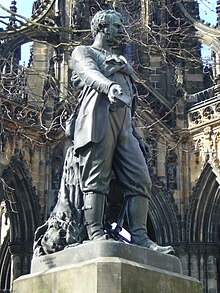
- A statue of Livingstone in Cathedral Square, Glasgow.
- A statue of Livingstone in Princes Street Gardens, Edinburgh.
- A bust of Livingstone is among those of famous Scotsmen in the Wallace Monument near Stirling.
- Strathclyde University, Glasgow (which evolved from Anderson's University, later the Royal College of Science and Technology), commemorates him in the David Livingstone Centre for Sustainability[85] and the Livingstone Tower where there is a statue of him in the building's foyer.
- The David Livingstone Room in the Royal College of Physicians and Surgeons of Glasgow.[86] A portrait of Livingstone by Thomas Annan (a photograph painted over in oils) hangs outside the room.[87]
- The David Livingstone (Anderson College) Memorial Prize in Physiology commemorates him at the University of Glasgow.
- Livingstone Place, a street in the Marchmont neighbourhood of Edinburgh.
- Livingstone Street in Addiewell.
- A memorial plaque commemorating the centenary of Livingstone's birth was dedicated in St. James's Congregational Church in Hamilton, the church he attended as a boy.[88]
- Livingstone lived at 17 Burnbank Road in Hamilton, South Lanarkshire, for a short time in 1862. The house still stands and has a memorial plaque outside. He was awarded the Freedom of the Town of Hamilton.[89]
London [edit]
- A statue of David Livingstone stands in a niche on the outer wall of the Royal Geographical Society on Kensington Gore, London, looking out across Kensington Gardens. It was unveiled in 1953.[90]
- Livingstone is one of the four houses at Eltham College.
Canada [edit]
- The Livingstone Range of mountains in southern Alberta.
- David Livingstone Elementary School, Vancouver.
- David Livingstone Community School, Winnipeg.
- Bronze bust in Halifax, Nova Scotia.
- Gold bust in the city of Borden, Ontario.
- Livingstone Avenue in Barrie, Ontario.
- Livingstone Street, St. John's, Newfoundland and Labrador, Canada.
United States [edit]
- The town of Livingston, California
- Livingstone College, Salisbury, North Carolina.
- Livingstone Adventist Academy, Salem, Oregon.
Livingston Falls, Busch Gardens, Tampa Bay
South America [edit]
- The Livingstone Healthservice in Jardìn Amèrica, Misiones, Argentina is named in his honour.[91]
Banknotes [edit]
In 1971–1998 Livingstone's image was portrayed on £10 notes issued by the Clydesdale Bank. He was originally shown surrounded by palm tree leaves with an illustration of African tribesmen on the back.[92] A later issue showed Livingstone against a background graphic of a map of Livingstone's Zambezi expedition, showing the River Zambezi, Victoria Falls, Lake Nyasa and Blantyre, Malawi; on the reverse, the African figures were replaced with an image of Livingstone's birthplace in Blantyre, Scotland.[93]
Science [edit]
The following species have been named in honour of David Livingstone:
- Livingston's cichlid, Nimbochromis livingstonii
- Livingstone's eland, Taurotragus oryx livingstonii
- Livingstone's fruit bat, Pteropus livingstonii
The mineral livingstonite is named in his honor.[94] It was described in 1874 from Mexico.
Portrayal in film and books [edit]
Livingstone has been portrayed by M.A. Wetherell in Livingstone (1925), Percy Marmont in David Livingstone (1936), Sir Cedric Hardwicke in Stanley and Livingstone (1939), Bernard Hill in Mountains of the Moon (1990) and Sir Nigel Hawthorne in the TV movie Forbidden Territory (1997).[95]
The 1949 comedy film Africa Screams is the story of a dimwitted clerk named Stanley Livington (played by Lou Costello), who is mistaken for a famous African explorer and recruited to lead a treasure hunt. The character's name appears to be a play on Stanley and Livingstone.
Out of Darkness, Shining Light (2019) by Petina Gappah is a fictionalized account of how Dr. Livingstone's body, papers, and maps traveled 1,500 miles across the continent of Africa, so his remains could be returned to England and his work preserved there.
In popular culture [edit]
The Moody Blues 1968 single "Dr. Livingstone, I Presume" paints the adventures of Livingstone, Captain Scott, and Columbus with the refrain "What did you find there? Did you stand awhile and stare? Did you meet anyone?", followed by a repeated chorus of "We're all looking for someone".
The ABBA song "What about Livingstone?"[96] mentions Livingstone "traveling up the Nile". Livingstone made 4 great journeys into Africa, three of them starting in Cape Town, South Africa and the last at Zanzibar. None of the routes traveled on the Nile which lay far to the north. He may have crossed sections of the headwaters of Nile on his final expedition but he would not have known so as these areas were not considered in the Nile watershed until much later.
Stanley's search for and discovery of Livingstone is the subject of the Hugh Masekela song "Witch Doctor" that appears on his 1976 album, Colonial Man.
See also [edit]
- Thomas Baines
- John Kirk
- Livingstone Inland Mission
- History of Christianity in Zambia
References [edit]
Notes [edit]
- ^ This sentiment today would be expressed along the lines of: "all people, worldwide, are brothers and sisters, despite everything."[8]
Citations [edit]
- ^ a b "David Livingstone (1813–1873)". BBC - History - Historic Figures. 2014. Retrieved 12 July 2018.
- ^ Easton, Mark (3 September 2017). "Why don't many British tourists visit Victoria Falls?". BBC News . Retrieved 12 July 2018.
- ^ a b c d e f g h i j k Jeal, Tim (2013). Livingstone: Revised and Expanded Edition. Yale University Press. ISBN978-0-300-19100-4.
- ^ Mackenzie, John M. (1990). "David Livingstone: The Construction of the Myth". In Walker, Graham; Gallagher, Tom (eds.). Sermons and battle hymns: Protestant popular culture in modern Scotland. Edinburgh University Press. ISBN978-0-7486-0217-9.
- ^ "David Livingstone Centre: Birthplace Of Famous Scot". Archived from the original on 12 February 2007. Retrieved 12 July 2018. CS1 maint: bot: original URL status unknown (link)
- ^ Ronald Black (1999), An Tuil: Anthology of 20th Century Scottish Gaelic Verse, p. 726.
- ^ a b c d e f g h i j Blaikie, William Garden (1880). The Personal Life of David Livingstone... Chiefly from His Unpublished Journals and Correspondence in the Possession of His Family. London: John Murray – via Project Gutenberg.
- ^ a b Vetch, Robert Hamilton (1893). "Livingstone, David". In Lee, Sidney (ed.). Dictionary of National Biography. 33. London: Smith, Elder & Co. p. 385.
- ^ "The University of Glasgow Story : David Livingstone". University of Glasgow. n.d. Retrieved 12 July 2018.
- ^ "David Livingstone a brief history". hamiltonurc.org.uk . Retrieved 30 October 2019.
- ^ Duncan, Alexander (1896). Memorials of the Faculty of Physicians and Surgeons of Glasgow, 1599–1850. Glasgow: MacLehose. pp. 100, 293.
- ^ Thema, B.C. (1968). "The Church and Education in Botswana During the 19th Century". Botswana Notes and Records. Botswana Society. 1: 1–4. JSTOR 40979214.
- ^ Livingstone, D.; Schapera, I. (1961). Livingstone's Missionary Correspondence, 1841-1856. University of California Press. p. 48. Retrieved 14 October 2021.
- ^ "The Personal Life of David Livingstone/CHAPTER IV". Wikisource, the free online library . Retrieved 15 October 2021.
- ^ Volz, Stephen (21 September 2021). "Molehabangwe, Mebalwe". Dictionary of African Christian Biography . Retrieved 14 October 2021.
- ^ "Digital Catalogue Record; liv_002823". Livingstone Online. 9 January 1845. Retrieved 15 October 2021.
Certificate of Marriage for David Livingstone and Mary (Moffat) Livingstone, Attested by Robert Moffat
- ^ Livingstone, David (1960). Isaac Schapera (ed.). Livingstone's private journals, 1851–1853. University of California Press. p. 304.
- ^ a b c Tomkins, Stephen (2013). David Livingstone: The Unexplored Story. Lion Books. ISBN978-0-7459-5568-1.
- ^ a b Holmes, Tim (1996). "The History". Spectrum Guide to Zambia. Struik. ISBN978-1-86872-012-5.
- ^ a b c Wisnicki, Adrian S.; Ward, Megan (2015). "Livingstone's Life & Expeditions". Livingstone Online . Retrieved 28 September 2021.
- ^ Livingstone to Lord Clarendon 19 March 1857 Clarendon Papers Bodleian Library Dep. c 80
- ^ C. A. Baker, "The Development of the Administration to 1897", in The Early History of Malawi, edited by Bridglal Pachai (London, Longman, 1972), p. 324.
- ^ Livingstone, David (1894). "CHAPTER I". A Popular Account of Dr Livingstone's Expedition to the Zambesi and its Tributaries. John Murray – via Wikisource.
- ^ Livingstone, David. "Personal Letter to J. Kirk or R. Playfair". David Livingstone Online. Archived from the original on 21 December 2014. Retrieved 10 December 2014.
- ^ Livingstone, David (2011). Wisnicki, Adrian S. (ed.). Livingstone's 1871 Field Diary: A Multispectral Critical Edition. UCLA Library.
- ^ a b c Wisnicki, Adrian S. (2011). "Livingstone in 1871". livingstoneonline.org . Retrieved 25 April 2019.
- ^ "Researchers now presume that Dr Livingstone lied". cbsnews.com. 2 November 2011. Retrieved 25 April 2019.
- ^ "Map of Livingstone's travels", National Museums of Scotland. The map is online here (subscription required)
- ^ "David Livingstone letter deciphered at last. Four-page missive composed at the lowest point in his professional life". Associated Press. 2 July 2010. Retrieved 2 July 2010.
- ^ Livingstone's Letter from Bambarre Archived 5 July 2010 at the Wayback Machine, emelibrary.org; accessed 4 July 2010.
- ^ a b Stanley, Henry Morton (1872). How I Found Livingstone: Travels, Adventures and Discoveries in Central Africa: Including an Account of Four Months' Residence with Dr. Livingstone. Scribner, Armstrong & Company.
- ^ a b c Jeal, Tim (2007). Stanley: The Impossible Life of Africa's Greatest Explorer. Yale University Press. ISBN978-0-300-12625-9.
- ^ a b Tomkins, Stephen (19 March 2013). "The African chief converted to Christianity by Dr Livingstone". BBC News . Retrieved 12 July 2018.
- ^ Horne, C. Silvester (1999). David Livingstone: Man of Prayer and Action. Christian Liberty Press. ISBN978-1-930092-11-2.
- ^ Wyon, Allen (February 1890). "A Livingstone Medal". Chronicles of the London Missionary Society. London: 60.
- ^ Wickens, G. E.; Lowe, P. (2008). The Baobabs: Pachycauls of Africa, Madagascar and Australia. Springer Netherlands. p. 33. ISBN978-1-4020-6430-2.
- ^ Bradford, Charles Angell (1933). Heart Burial. London: Allen & Unwin. p. 242. OCLC 10641494.
- ^ G. Bruce Boyer (Summer 1996). "On Savile Row". Cigar Aficionado. Archived from the original on 17 August 2010. Retrieved 21 December 2009.
- ^ David Livingstone. Westminster-abbey.org, retrieved 23 October 2015.
- ^ Teelock, Vijayalakshmi; Peerthum, Satyendra (2017). Transition from Slavery in Zanzibar and Mauritius. CODESRIA. pp. 47–. ISBN978-2-86978-680-6.
- ^ Rijpma, Sjoerd (2015). David Livingstone and the Myth of African Poverty and Disease: A Close Examination of his Writing on the Pre-colonial Era. BRILL. pp. 161–. ISBN978-90-04-29373-1.
- ^ Stirling, Leader (1977). Tanzanian Doctor. Montreal: McGill-Queen's University Press. ISBN978-0-7735-9393-0.
- ^ Barnett, Correlli (1986). The Audit of War: The Illusion and Reality of Britain as a Great Nation. MacMillan. ISBN978-0-333-35376-9.
- ^ Neill, Stephen; Chadwick, Owen (1990). A History of Christian Missions. Penguin Books. p. 315. ISBN978-0-14-013763-7.
- ^ Alvyn Austin, "Discovering Livingstone" Christian History (1997) 16#4 pp 10-19.
- ^ "The Top 100 Great Britons". Archived from the original on 4 December 2002. Retrieved 19 July 2017. CS1 maint: bot: original URL status unknown (link)
- ^ "Obituaries". Appletons' annual cyclopaedia and register of important events of the year: 1862. New York: D. Appleton & Company. 1863. p. 687.
- ^ Chirgwin, A. M. (1934). "New Light on Robert Livingstone". Journal of the Royal African Society. 33 (132): 250–252. JSTOR 716469.
- ^ Murray, John (August 2011). "Rupert Vincent, I Presume?". Crossfire . Retrieved 12 July 2018.
- ^ Steven Wilson. "Livingstone Descendants". Freepages.genealogy.rootsweb.ancestry.com. Retrieved 23 January 2012.
- ^ Ferguson, Niall (2002). Empire: The Rise and Demise of the British World Order and the Lessons for Global Power . Basic Books. p. 158. ISBN978-0-465-02329-5.
- ^ David Livingstone Spectral Imaging Project, livingstone.library.ucla.edu; accessed 30 March 2014.
- ^ "Images of Livingstone letter now available online". SOAS, University of London. 15 December 2008. Retrieved 7 March 2013.
- ^ "Scottish explorer David Livingstone's writings, drawings now available through online archive". Life at OSU. 24 June 2015. Retrieved 19 February 2019.
- ^ "Livingstone Online: An Introduction | Livingstone Online". www.livingstoneonline.org . Retrieved 19 February 2019.
- ^ a b c "David Livingstone Remembered". Archived from the original on 27 September 2007. Retrieved 27 April 2007.
- ^ Michler, Ian (2007). Victoria Falls & Surrounds: The Insider's Guide. Penguin. p. 11. ISBN978-1-77007-361-6.
- ^ David Livingstone's statue. Victoria Falls. 1934. Archived from the original on 9 March 2015. Retrieved 30 January 2015.
- ^ "David Livingstone Clinic - University of Strathclyde".
- ^ Grant, C. H. B. (April 1932). "The Livingstone-Stanley Memorials in Africa". The Geographical Journal. 79 (4): 318–319. doi:10.2307/1784331. ISSN 0016-7398. JSTOR 1784331.
- ^ "DR LIVINGSTONE PRIMARY SCHOOL - NAIROBI". dr.livingstone.primary.school.co.ke.
- ^ Lottering, Francois (28 October 2016). "Museum to honour David Livingstone". The Namibian. p. 7.
- ^ "David Livingstone Centre for Sustainability webpage". Archived from the original on 7 August 2012.
- ^ "David Livingstone Meeting & Function Room | Fifteen Ninety Nine". fifteenninetynine.co.uk. Archived from the original on 31 May 2016. Retrieved 23 August 2016.
- ^ Andrew McAinsh (5 January 2016). "Thomas Annan and the Documentary Photograph". College Library . Retrieved 23 August 2016.
- ^ "David Livingstone – a brief history". Hamilton.urc.org.uk. 13 January 2012. Retrieved 7 March 2013.
- ^ Blaikie, William Garden (2004) [1880], The Personal Life of David Livingstone, Project Gutenberg
- ^ "Unveiling of the Livingstone Statute". The Geographical Journal. 120 (1): 15–20. 1954. doi:10.2307/1791984. ISSN 0016-7398. JSTOR 1791984.
- ^ "Livingstone Healthservice". Archived from the original on 4 March 2016. Retrieved 7 March 2013.
- ^ "Clydesdale 10 Pounds, 1982". Ron Wise's Banknoteworld. Archived from the original on 21 October 2008. Retrieved 15 October 2008.
- ^ "Clydesdale 10 Pounds, 1990". Ron Wise's Banknoteworld. Archived from the original on 21 October 2008. Retrieved 15 October 2008.
- ^ Barcena, M (1874). "On livingstonite, a new mineral". American Journal of Science. 108: 145–146.
- ^ Forbidden Territory: Stanley's Search for Livingstone (1997) at IMDb
- ^ Sheridan, Simon (2012). The Complete ABBA (40th Anniversary ed.). Titan Books. p. 69. ISBN978-0857687241.
Sources and further reading [edit]
- Austin, Alvyn. "Discovering Livingstone" Christian History (1997) 16#4 pp. 10–19.
- Dugard, Martin (2012). Into Africa: The Epic Adventures Of Stanley And Livingstone. Transworld. ISBN978-1-4464-3720-9.
- Dugard, Martin (2014). The Explorers: A Story of Fearless Outcasts, Blundering Geniuses, and Impossible Success. Simon and Schuster. ISBN978-1-4516-7757-7.
- Holmes, Timothy (1993). Journey to Livingstone: Exploration of an Imperial Myth. Edinburgh: Canongate Press. ISBN 978-0-86241-402-3; scholarly biography
- Jeal, Tim (1973). Livingstone. London: Heinemann. ISBN978-0-434-37208-9. , scholarly biography
- Jeal, Tim (1973b). Livingstone. New York: G. P. Putnum's Sons. ISBN9780399112157. LCCN 73-82030. , first American edition
- Livingstone, David (1857). Missionary Travels and Researches in South Africa: Including a Sketch of Sixteen Years' Residence in the Interior of Africa. London: Murray. p. Contents.
- Livingstone, D.; Livingstone, C. (1866). Narrative of an Expedition to the Zambesi and Its Tributaries: And of the Discovery of the Lakes Shirwa and Nyassa. 1858–1864. Harper & Brothers.
- Livingstone, David (1874). Waller, Horace (ed.). The Last Journals of David Livingstone, in Central Africa, from 1865 to His Death: Continued by a Narrative of His Last Moments and Sufferings, Obtained from His Faithful Servants Chuma and Susi; in Two Volumes. J. Murray.
- Livingstone, David and James I. Macnair (eds) (1954). Livingstone's Travels. London: J.M. Dent.
- Livingstone, David (1999) [1875]. Dernier Journal. Paris: Arléa; ISBN 2-86959-215-9 (in French)
- Maclachlan, T. Banks. David Livingstone, Edinburgh: Oliphant, Anderson and Ferrier, 1901, ("Famous Scots Series").
- Martelli, George (1970). Livingstone's River: A History of the Zambezi Expedition, 1858–1864. London: Chatto & Windus. ISBN 978-0-7011-1527-2
- Milbrandt, Jay (2014). The Daring Heart of David Livingstone: Exile, African Slavery, and the Publicity Stunt that Saved Millions. Nashville, TN: Thomas Nelson. ISBN978-1-59555-592-2. scholarly biography
- Mathews, Basil Joseph, Livingstone, the Pathfinder, illustrated by Ernest Prater (Oxford and London: Henry Frowde Oxford University Press, 1913)
- Morrill, Leslie, and Madge Haines (1959). Livingstone, Trail Blazer for God. Mountain View: Pacific Press Publication Association.
- Philip, M. NourbeSe (1991). Looking for Livingstone: An Odyssey of Silence. Stratford: The Mercury Press; ISBN 978-0-920544-88-4
- Rea, W. F. "Livingstone's Rhodesian Legacy." History Today (Sept 1973), Vol. 23 Issue 9, pp. 633–639 online.
- Ross, Andrew (2002). David Livingstone : Mission and Empire. London: Hambledon Continuum. ISBN978-1-85285-285-6.
- Seaver, George. David Livingston: His Life and Letters (1957), a standard biography
- Shepperson, George. "David Livingstone 1813–1873: a centenary assessment." Geographical Journal (1973): 205–219. doi:10.2307/1796089
- Stuart, John. "David Livingstone, British Protestant missions, memory and empire." in Dominik Geppert, ed., Sites of imperial memory (Manchester University Press, 2016).
- Waters, John (1996). David Livingstone: Trail Blazer. Leicester: Inter-Varsity; ISBN 978-0-85111-170-4
- Wisnicki, Adrian S. (2009). "Interstitial Cartographer: David Livingstone and the Invention of South Central Africa". Victorian Literature and Culture 37.1 (Mar.): 255–71.
External links [edit]
-
 Media related to David Livingstone at Wikimedia Commons
- Livingstone Online
- Livingstone Spectral Imaging Project. Many of Livingstone's original papers spectrally imaged.
- Livingstone Online – Explore the manuscripts of David Livingstone Images of original documents alongside transcribed, critically edited versions
- David Livingstone (c. 1956). Archive film from the National Library of Scotland: Scottish Screen Archive
- Works by David Livingstone at Project Gutenberg
- Missionary Travels and Researches in South Africa
- A Popular Account of Dr Livingstone's Expedition to the Zambesi and its Tributaries
- The Personal Life of David Livingstone
- Works by or about David Livingstone at Internet Archive
- "Dr. Livingston (obituary, Wed., 28 Jan. 1874)". Eminent Persons: Biographies Reprinted from the Times. Vol. 1–6. D. Vol I, 1870–1875. Macmillan & Co.: 225–236 1892.
- The Lost Diary of Dr. Livingstone Documentary produced by the PBS Series Secrets of the Dead
- How Livingstone discovered the Falls. by J. Desmond Clark M.A. PH.D. F.S.A. Curator of the Rhodes-Livingstone Museum. 1955
- Interactive map of Dr. Livingstone's Zambezi expedition